

Bankroll Management in Poker: A Complete Guide to Managing Your Poker Funds
If you’ve played poker for any serious amount of time, you’ve probably experienced it: you run well for weeks, feel confident, maybe even invincible — and then everything turns around. Good hands get cracked. Bluffs don’t work. You start questioning your game.
That’s variance.
And this is exactly why bankroll management in poker matters. It’s not about being overly cautious. It’s about surviving the natural swings of the game so you can keep playing long enough for skill to show. A structured approach to long-term poker strategy helps players stay rational during downswings and avoid emotionally driven decisions.
What Is Poker Bankroll Management?
Definition & Purpose
Poker bankroll management simply means this: you set aside money strictly for poker, and you manage it with rules.
It’s not rent money. It’s not savings. It’s a dedicated poker fund. The goal is to protect yourself from going broke during normal losing stretches.
Poker has built-in uncertainty. Even if you consistently make correct decisions, short-term results can go against you. Understanding that concept — often described as variance — is essential. You can read more about the idea of variance in probability theory on Wikipedia.
Good bankroll management in poker allows you to keep playing through those inevitable swings without financial stress.
Why It Matters for Online & Live Play
Online games move fast. You might play hundreds of hands per hour. That increases short-term swings dramatically. Live games are slower, but pots are often larger relative to stacks, which creates pressure in different ways.
Separating your poker bankroll from your personal finances protects your mindset. When you’re not worried about bills or real-life expenses, decisions become clearer and less emotional.
Protect your poker bankroll while enjoying the game. Apply smart bankroll management and start playing confidently today.
Core Concepts in Bankroll Management
Variance: The Ups & Downs of Poker
Variance is not bad luck. It’s a mathematical reality. You can get your money in with the best hand and still lose repeatedly over a short sample.
This is where bankroll management in poker becomes practical. The deeper your bankroll relative to the stakes, the easier it is to absorb downswings without panic.
Risk of Ruin (RoR) and Why It Matters
Risk of Ruin describes the chance that your bankroll hits zero before your edge has time to materialize. If you’re under-rolled for the stakes, even a normal downswing can wipe you out.
The smaller your bankroll cushion, the more fragile your position becomes. Proper structure dramatically lowers that risk.
Win-Rate and Its Impact on Bankroll Size
Your win-rate matters — but not as much as you think in the short term.
Yes, a strong player with a solid edge can survive on a slightly smaller bankroll than a marginal winner. But variance does not disappear just because you’re skilled. Even strong players experience long break-even or losing stretches.
That’s why disciplined bankroll management in poker applies at every skill level.
Bankroll Rules for Cash Games
How Many Buy-Ins You Need
For online No-Limit Hold’em cash games, many experienced players recommend at least 50–100 buy-ins.
If you play $0.50/$1 with a $100 buy-in:
- 50 buy-ins = $5,000
- 100 buy-ins = $10,000
More conservative players prefer 80–120 buy-ins, especially if they multi-table or play aggressively.
The more volatile the game, the more buy-ins you should have.
Cash Game Bankroll Examples
| Stakes | Buy-In | 50 Buy-Ins | 100 Buy-Ins |
| $0.05/$0.10 | $10 | $500 | $1,000 |
| $0.25/$0.50 | $50 | $2,500 | $5,000 |
| $0.50/$1 | $100 | $5,000 | $10,000 |
| $1/$2 | $200 | $10,000 | $20,000 |
These are not rigid rules — they’re safety guidelines.
Adjusting for Game Type (PLO, Limit, NL)
Pot-Limit Omaha swings harder than NLHE because equities run closer. You’ll see more big pots and more dramatic turnarounds. That means deeper bankrolls — often 100+ buy-ins.
Fixed-limit formats tend to have smaller bet sizes per hand, which can slightly reduce required bankroll depth, but variance still exists.
Bankroll Management for Tournaments
Why Tournaments Need Bigger Bankrolls
Tournament variance is brutal. You can play perfectly and bust before the money dozens of times in a row.
That’s because payouts are top-heavy. A large portion of the prize pool goes to a small percentage of players.
Buy-In Guidelines by Format
- Regular MTTs: 100–200 buy-ins
- Large field MTTs: 200–300+ buy-ins
- Sit & Go tournaments: 50–150 buy-ins
- Hyper-turbo formats: lean toward the higher end
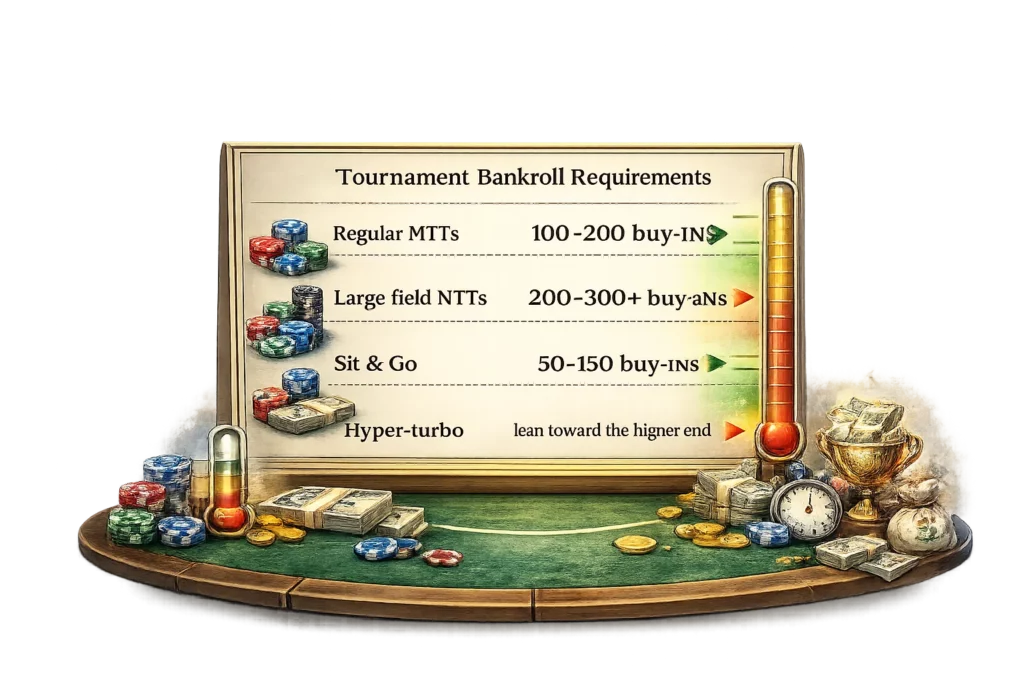
Bankroll management in poker becomes even more important in tournaments because downswings can last for months.
Bankroll Management for Online Poker
Online vs Live Bankrolls
Online play increases variance simply because you play more hands. More volume equals more exposure to short-term swings.
Live games might allow slightly shallower bankrolls due to slower pace, but session lengths and table conditions still matter.
Multi-Tabling and Variance
If you’re playing multiple tables at once, variance compounds faster. You might experience a ten buy-in swing in a single evening.
Many players track separate bankroll segments for cash, MTTs, and other formats to maintain clarity.
Tracking Across Sites
If you play on multiple platforms, track everything together. Your bankroll is the total amount allocated to poker — not just what sits on one site.This is especially important for players who regularly participate in ring games, where money remains in play at all times.
Practical Bankroll Approaches
Conservative Strategy
- 80–120 buy-ins for cash
- Upper buy-in recommendations for tournaments
This minimizes stress and reduces the risk of ruin.
Standard Strategy
- 50–80 buy-ins for cash
- 100–150 buy-ins for tournaments
Balanced growth with manageable risk.
Aggressive Strategy
- 30–40 buy-ins for cash
- Lower MTT thresholds
This increases growth potential but dramatically raises risk. It requires emotional control and strict rules for moving down.
Adjusting Stakes the Smart Way

When to Move Up
Move up only when your bankroll comfortably supports the next level based on your rules. Never move up just because you feel confident after a good week.
When to Move Down
If your bankroll drops below your minimum buy-in requirement, move down immediately. This protects your long-term ability to play.
There is no shame in moving down. It is a strategic decision.
Taking Shots Carefully
Allocate a small number of buy-ins — maybe 2 to 5 — for a shot at higher stakes. If they’re lost, return to your regular level without hesitation.
Psychological Aspects of Bankroll Management
Handling Losing Streaks
Losing streaks are part of poker. Without clear bankroll rules, players often chase losses or jump stakes impulsively.
Structure removes emotional decision-making.
Stop-Loss & Stop-Win Rules
Setting session loss limits prevents tilt spirals. Stop-win rules help avoid giving back profits due to overconfidence.
Mental Benefits of Bankroll Discipline
When you know your bankroll is properly structured, single sessions matter less. That mindset improves focus and reduces stress.
Strong bankroll management in poker strengthens both financial stability and emotional stability.
Bankroll Tools & Tracking
Spreadsheets & Apps
Many players use simple spreadsheets to track:
- Starting bankroll
- Daily results
- Stake changes
- Monthly summaries
Some apps automate this process and sync across devices.
Variance Calculators
Risk calculators estimate how large your bankroll should be based on win-rate and volatility. They help visualize acceptable risk levels.
Integrating Hand Reviews
Tracking results alongside hand reviews creates clarity. Tools like PokerTracker allow players to analyze both performance and financial swings together.
Take Control of Your Poker Funds
Poker rewards discipline over time. Build a clear structure, respect variance, and protect your ability to keep playing. Strong bankroll management in poker is not optional — it is the foundation of long-term survival.
FAQ
How do I get started with bankroll management in poker?
Set aside a dedicated poker fund. Choose conservative buy-in rules and commit to them without exception.
Should I separate cash and tournament bankrolls?
Yes. Their variance profiles differ significantly.
Can freerolls help build a bankroll?
Yes. They reduce financial risk while building experience.
What do professionals say about bankroll rules?
Most professionals favor conservative structures. Longevity matters more than short-term growth.