








What Is Poker? Basics You Need to Know
Poker is a card game where players compete to win chips either by holding the strongest five-card hand at showdown or by forcing opponents to fold before the showdown happens.
Wikipedia defines poker as a family of comparing card games where players wager over which hand is best according to the rules of that specific variant.
This definition highlights two important elements: comparison and wagering. Poker is not only about the cards you receive. It is also about how you represent your hand through betting.
At its core, poker is a decision-making game under uncertainty. You never have complete information. Strategy is built around probabilities and opponent behavior rather than certainty.
Understand the rules, master decision-making under uncertainty, and build a strong foundation before you sit at the table.
How Poker Works (Game Flow & Actions)
A typical poker hand follows a structured sequence. Players receive private cards. Betting rounds occur. In community-card games like Texas Hold’em, shared cards are revealed in stages. After the final betting round, remaining players compare hands at showdown.
The four core actions are:
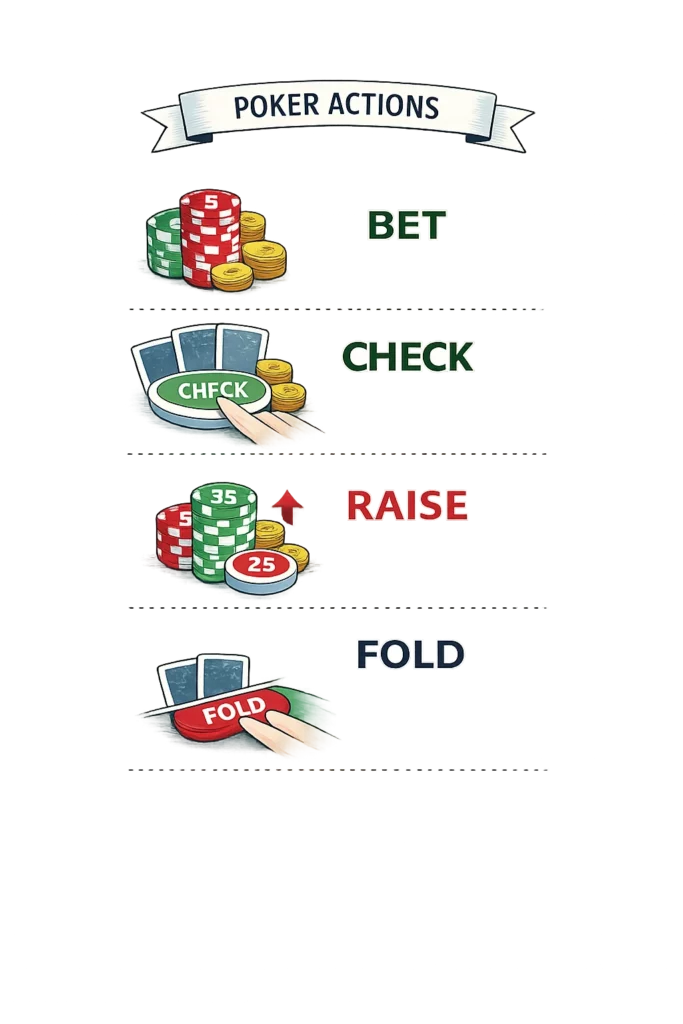
Bet — place chips into the pot
Check — decline to bet when no bet exists
Raise — increase a previous bet
Fold — surrender your hand
Every decision affects the pot size and how opponents react. Good players think one step ahead. Instead of reacting emotionally, they consider what their action represents and how it influences the rest of the hand.
Most Popular Online Poker Variants
Online platforms usually offer multiple formats, but beginners should focus on one main game before branching out.
Texas Hold’em: Rules & Structure
In Texas Hold’em, each player receives two private cards. Five community cards are revealed in three stages: the flop, the turn, and the river. Players can use any combination of their hole cards and the board to make the best five-card hand.
Hold’em is widely considered the best starting point because hand evaluation is relatively straightforward and ranges are easier to understand.
Omaha & Other Variants (overview only)
Omaha gives players four private cards, but they must use exactly two of them along with three community cards. Because of the extra combinations, average hand strength increases and post-flop play becomes more complex.
Beginners are usually better off mastering Hold’em fundamentals before transitioning to Omaha.
Poker Hand Rankings
All major poker variants use the same ranking system. Understanding hand strength instantly is essential for avoiding costly mistakes.
From strongest to weakest: These rankings are especially important when playing cash game formats, where every decision directly impacts your bankroll.
- Royal Flush
- Straight Flush
- Four of a Kind
- Full House
- Flush
- Straight
- Three of a Kind
- Two Pair
- One Pair
- High Card
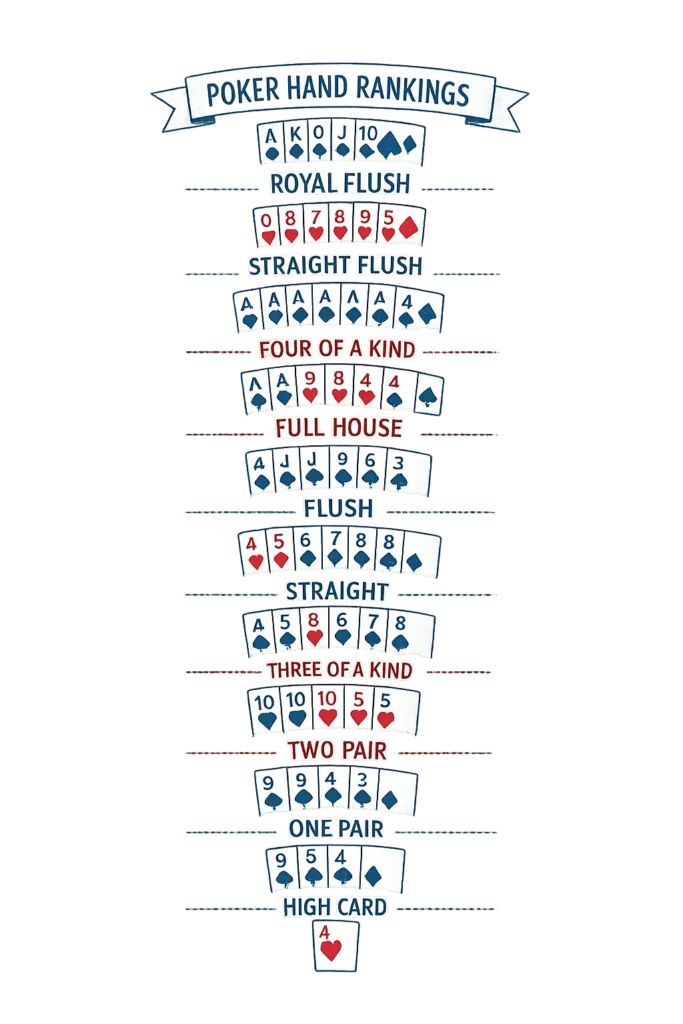
Recognizing relative strength is just as important as memorizing rankings. A pair might be strong on one board and weak on another.
Online vs. Live Poker: Key Differences
What Changes When You Play Online
Online poker is significantly faster than live poker. There is no physical dealing. Betting is automated. Decisions must be made within a visible timer.
Players can also multi-table, meaning they play multiple games simultaneously. This increases volume but reduces time per decision.
Software tools such as HUDs (Heads-Up Displays) track long-term statistics, which adds an analytical layer that does not exist in most live games.
Table Layout, Timer & Software Interface Explained
Online tables display stack sizes, pot amounts, bet sizes, and action timers. The timer ensures that players cannot stall indefinitely.
Understanding the interface prevents costly mistakes. Clicking the wrong button or acting too quickly can misrepresent your intended strategy
Reading Opponents Online vs. Live
In live poker, players rely on physical tells — posture, speech, or nervous behavior. Online poker removes those elements.
Instead, players observe betting frequency, timing, and sizing patterns. For example, someone who consistently raises from late position likely has a wider range. Over time, statistical tendencies become more reliable than physical reads.
Essential Pre-Flop Strategy for Beginners
Pre-flop decisions form the foundation of profitable play. Most beginner leaks originate before the flop.
Starting Hand Selection
You cannot play every hand profitably. Selectivity reduces difficult post-flop spots and protects your stack.
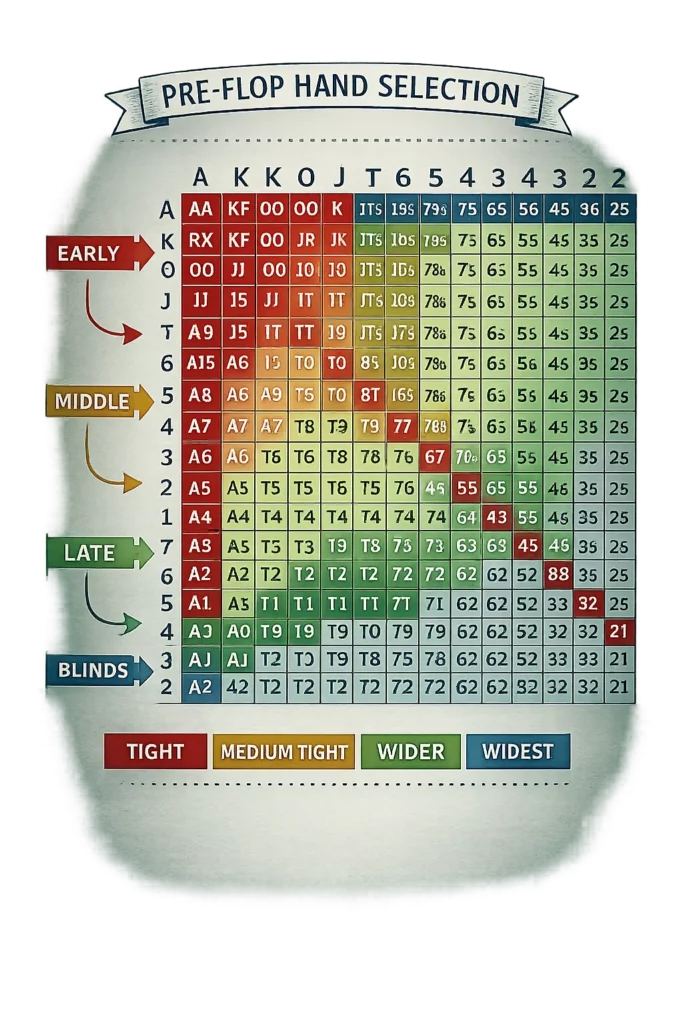
Tight & Aggressive Basics
A tight-aggressive approach means entering pots with strong hands and applying pressure through raises rather than passive calls. This style simplifies decision-making and reduces marginal spots.
What Hands to Play in Early Position
Early position requires caution. Acting first gives you the least information. Stick to strong pairs and high-card combinations.
Loose play from early position often leads to difficult decisions later in the hand.
Expanding Ranges in Late Position
Late position provides informational advantage. After seeing others act, you can widen your range slightly.
Position allows you to control pot size and apply pressure more effectively.
Opening, Folding, Raising — When to Do What
Opening with a raise establishes initiative. Folding weak hands conserves chips. Raising instead of limping builds structure and discourages multi-way pots.
Use tight-aggressive fundamentals and make confident, disciplined decisions at the table.
Post-Flop Strategy Fundamentals
The flop changes range dynamics. Now you can compare your hand to the visible board.
Understanding Board Texture
Board texture refers to how coordinated or disconnected the community cards are. A dry board contains few drawing possibilities. A wet board allows straights and flush draws.
On wet boards, stronger hands and stronger draws are common. On dry boards, weaker made hands can hold up more often.
How to Continue After the Flop
Continuation betting works when the board favors your pre-flop range. However, blindly betting every flop is not strategy.
Value betting extracts chips from worse hands. Bluffing attempts to fold out better hands. Understanding which situation applies requires board awareness and opponent tendencies.
Managing Pots & Aggression Online
Controlled aggression builds consistent profit. Over-aggression without equity leads to large losses.
Managing pot size with medium-strength hands reduces variance and protects your tournament life or session bankroll.
Position Is Power — How to Use It
Why Position Matters in Every Hand
Position determines information flow. Acting last provides insight into opponents’ decisions before making your own.
Over many hands, this advantage compounds into measurable profit.
How to Adjust Your Ranges by Position
Play tighter in early positions. Widen ranges progressively as position improves. Avoid defending weak hands out of position.
Strategic adjustments by seat location separate structured players from reactive ones.
Smart Bluffing for Beginners
What Is Bluffing & When It Works
Bluffing attempts to win without the strongest hand. It works best when your story is consistent with prior actions.
Bluffs without logical backing tend to fail against observant opponents.
Semi-Bluffing with Equity
Semi-bluffing includes drawing potential. Even if called, you can still improve on later streets.
Pure Bluffs: High-Risk & When to Avoid Them
Pure bluffs carry higher risk because they rely entirely on fold equity. Beginners should apply them selectively and avoid multi-way situations.
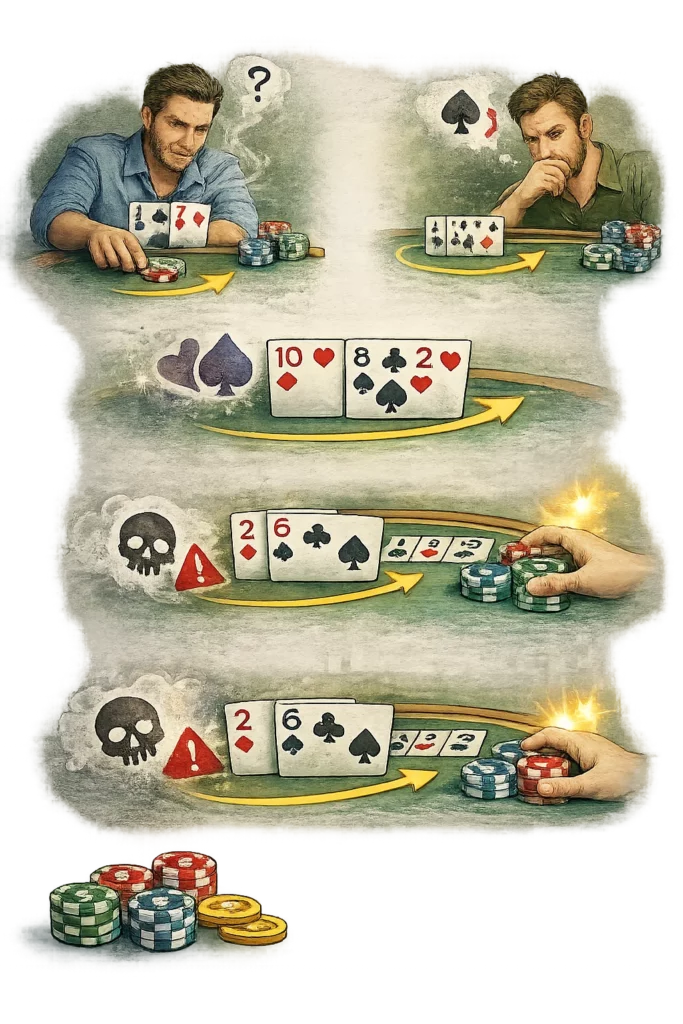
Pot Odds, Expected Value & Basic Math
What Are Pot Odds & Why They Matter
Pot odds compare the size of a call to the total pot. They help determine whether a call is profitable over time.
Understanding basic probability prevents emotional calls.
Expected Value (EV) Simplified
Expected Value measures long-term profitability of a decision. A play with positive EV may not win immediately but remains correct over many repetitions.
Applying Odds to Real-World Hands
When drawing to a flush or straight, compare the cost of calling to the likelihood of completing your hand. Mathematics supports disciplined folding when odds are unfavorable.
Observing Opponents: Notes & Patterns
Online Betting Patterns to Watch
Observe who raises frequently and who calls too much. These tendencies reveal exploitable patterns.
Physical vs Timing Tells (Online)
Online timing patterns replace physical tells. Instant bets or unusual delays can indicate strength or uncertainty.
How to Note Opponent Tendencies
Taking notes allows you to categorize players as aggressive, passive, or tight. This information shapes future decisions.
Take control of your strategy, play with discipline, and build steady progress at the tables.
Common Mistakes New Players Make
Playing Too Many Hands
Loose pre-flop selection leads to complex post-flop situations and unnecessary losses.
Limping Instead of Raising
Limping invites multiple opponents into the pot cheaply. Raising builds pressure and defines ranges more clearly.
Calling Too Often & Misreading Value
Calling without understanding relative hand strength slowly reduces stack size. A single pair is not always strong enough to justify multiple calls.Proper bankroll management helps minimize long-term losses caused by these common mistakes.
Ignoring Position & Odds
Neglecting position and pot odds leads to mathematically incorrect decisions and predictable losses.
Starting with a Solid Mental Game
Practice Sites & Free Play Options
Folding preserves chips and reduces emotional swings. Strong players fold often because they wait for profitable spots.
Avoiding Tilt (Emotional Decision-Making)
Tilt occurs when emotions override logic. Recognizing frustration early prevents cascading mistakes.
Building Discipline Online
Online speed encourages impulsive action. Discipline means pausing mentally before clicking.
Tools & Resources for Beginners
Practice Sites & Free Play Options
Free tables allow experimentation without financial risk. They are ideal for learning structure and mechanics.
Strategy Tools (HUDs, Trackers)
Tracking software collects long-term data. Used responsibly, it helps identify patterns and leaks.
Structured training programs provide guided learning paths for beginners.
Forums and discussion groups expose players to alternative perspectives and deeper analysis.
How to Keep Improving Over Time
Reviewing Your Hands
Post-session reviews reveal repeated errors and strategic leaks.
Tracking Results & Patterns
Recording outcomes highlights consistency or volatility in decision-making.
Learning from Online Strategy Communities
Forums and discussion groups expose players to alternative perspectives and deeper analysis.
Take Your First Strategic Step
Start applying disciplined pre-flop and post-flop fundamentals at beginner-friendly tables designed for steady improvement.