

Cash Game Strategy Guide: How to Win at Online Poker Cash Games
Online cash games remain one of the most consistent and skill-driven formats in modern poker. Unlike tournaments, where survival is tied to blind increases and payout structures, cash games reward steady decision-making over time. This cash game strategy guide explains how online poker cash games work, how to structure your pre-flop and post-flop approach, and how to manage your bankroll for sustainable results.
What Is a Cash Game?
A cash game is a poker format where chips represent real money value at all times. If you buy in for $100 at a $0.50/$1 table, each chip directly corresponds to dollars. You can leave the table whenever you want and cash out your stack.
For a general overview of how poker formats function, see Wikipedia.
How Cash Games Work Online
Online cash games operate with fixed blind levels that do not increase. For example, at a $0.50/$1 No-Limit Hold’em table, blinds remain constant for the entire session. Players may join or leave tables freely, and buy-ins are usually capped at 100 big blinds (though deep stack tables exist). Understanding basic poker strategy is essential for making consistent decisions in this format.
Differences vs. tournaments:
- Chips have real money value.
- Blinds do not increase.
- There is no prize pool structure.
- Players can rebuy at any time.
This structure emphasizes long-term win rate rather than short-term survival.
Apply solid strategy at fixed blind tables and focus on long-term profitability rather than short-term swings.
Key Formats & Stakes Online
The most common online cash game formats include:
- No-Limit Texas Hold’em (NLHE)
- Pot-Limit Omaha (PLO)
- Fixed-Limit and No-Limit structures
Stakes range from micro (e.g., $0.01/$0.02) to high stakes ($5/$10 and above). Micro and low stakes often feature looser players, while mid and high stakes demand stronger theoretical foundations.
Cash Game Terminology Every Player Should Know
Understanding core terminology improves both study and table performance:
- Blinds – Forced bets that start each hand.
- Rake – The small fee taken by the poker room.
- VPIP – Voluntarily Put Money in Pot (percentage of hands played).
- PFR – Pre-Flop Raise percentage.
- HUD – Heads-Up Display showing statistical data.
These metrics are critical when analyzing opponent tendencies.
Online vs. Live Cash Game Strategy
Major Differences Between Online & Live Play
Online games deal significantly more hands per hour. Decisions must be faster, and players often rely on data rather than physical reads. Many online players use tracking software and HUD statistics.
Live games, by contrast, progress slowly and allow observation of physical behavior. Body language and betting timing provide additional information. In both formats, disciplined bankroll management remains the foundation of long-term profitability.
Online:
- Higher volume of hands.
- Faster pace.
- Access to HUD data.
Live:
- Slower tempo.
- Physical reads.
- Often softer player pools at lower stakes.
Table Dynamics & Opponent Pools Online
Online pools tend to be more aggressive and technically competent. Multi-tabling players frequently follow structured ranges. At lower stakes, recreational players may still overplay weak hands, creating exploitative opportunities.
Advantages of Learning Online Strategy
Studying online strategy improves discipline, statistical understanding, and pattern recognition. Because of higher hand volume, players can review large data samples and accelerate improvement.
Pre-Flop Fundamentals in Online Cash Games
Starting Hand Selection (Tight-Aggressive Basics)
At most stakes, “tight is right.” A tight-aggressive (TAG) approach involves playing fewer hands but betting assertively when entering pots. Premium hands such as AA, KK, QQ, and AK should almost always be raised.
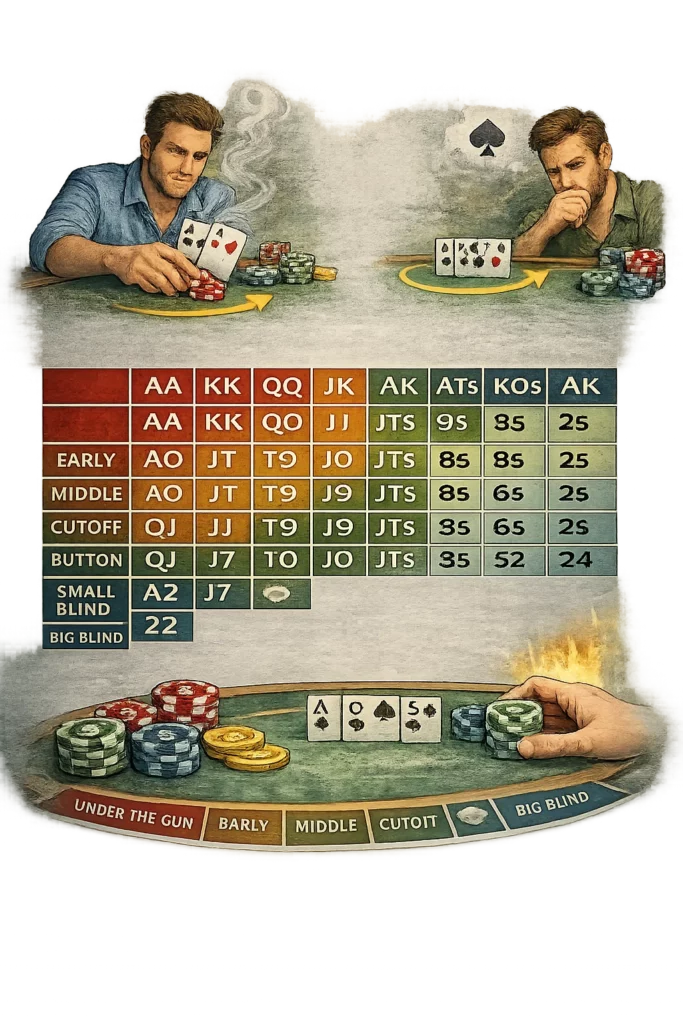
Opening ranges widen in late position and tighten under the gun. Structured pre-flop discipline reduces marginal situations post-flop.
When to Raise, Call & Fold Pre-Flop
Raising builds initiative and defines hand strength. Calling without a clear plan often leads to difficult spots.
General guidelines:
- Raise strong hands.
- Avoid limping.
- Fold weak, dominated holdings.
- Call selectively in position with suited connectors or small pairs.
Positional Awareness & Opening Ranges
Position strongly influences profitability. Early position requires tighter ranges because multiple players act behind you. Late position allows wider opens and more frequent steals.
The button is typically the most profitable seat at the table.
Post-Flop Strategy Essentials
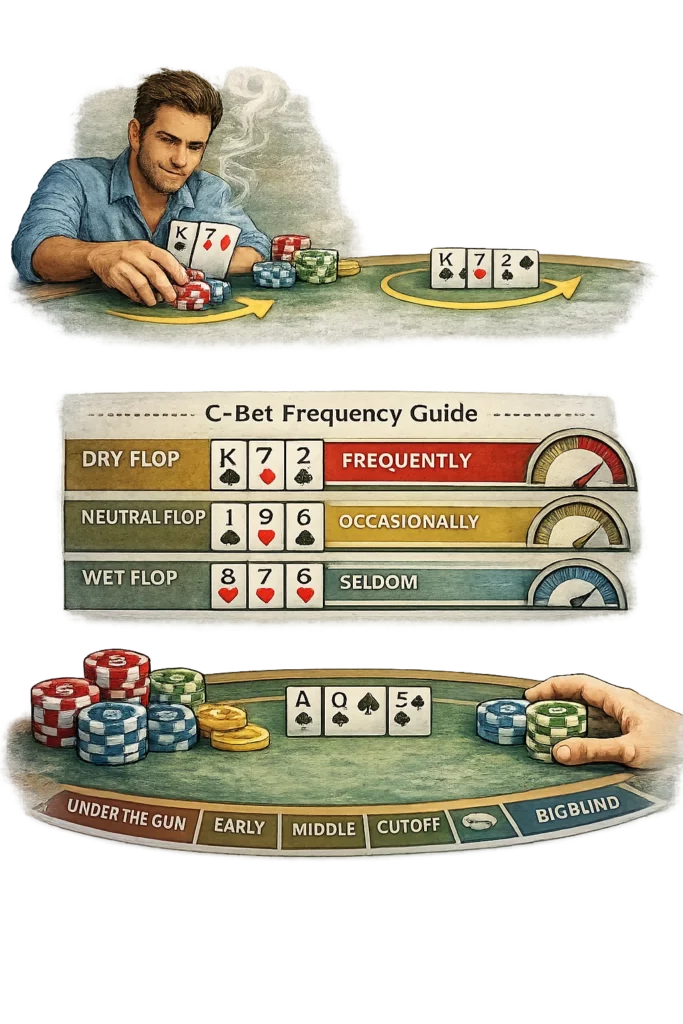
Continuation Betting (C-Bet) in Position
A continuation bet follows a pre-flop raise and applies pressure on favorable boards. Boards that are dry (e.g., K-7-2 rainbow) are ideal for higher c-bet frequency.
Balanced c-betting prevents opponents from exploiting predictable patterns.
Protecting Strong Hands for Value
Strong holdings should be bet or raised to charge draws and extract value. Slow playing can be effective in rare cases but often reduces profitability.
Bet sizing should reflect board texture and opponent tendencies.
Bluffing & Semi-Bluffing Techniques
Bluffing works best against players capable of folding. Semi-bluffs with draws add equity if called. Effective bluffing considers blockers, range advantage, and opponent fold frequency.
Pot Control with Medium Strength Hands
Medium hands (e.g., second pair) benefit from pot control. Checking behind or calling instead of raising helps avoid difficult river decisions and preserves showdown value.
Advanced Online Cash Game Concepts
Exploitative vs. Balanced (GTO) Play
Exploitative play targets opponent mistakes. Balanced or Game Theory Optimal (GTO) play protects against being exploited.

Against weaker opponents, exploitative adjustments often yield higher profits. Against skilled regulars, balanced strategies reduce predictability.
Value Betting & Thin Value Spots
Thin value betting involves extracting small amounts of value with hands slightly ahead of an opponent’s calling range. Recognizing these spots increases long-term win rate.
Reading Opponents Using HUD Stats & Patterns
HUD stats such as VPIP, PFR, and aggression frequency reveal tendencies. For example:
- High aggression factor indicates frequent betting.
- High VPIP + low PFR suggests a passive player.
Patterns across multiple hands offer clearer insights than single observations.
Adjusting to Opponent Types
- Calling stations: Value bet heavily; avoid excessive bluffing.
- Aggressive players: Trap with strong hands and call lighter when ranges are wide.
- Tight players: Steal blinds more frequently.
Adapting to player type remains central to successful online cash game strategy.
Bankroll Management for Online Cash Games

Importance of Bankroll Planning
Bankroll discipline protects against variance. A common recommendation is 30–50 buy-ins for your chosen stake. For a $0.50/$1 game with a $100 buy-in, this means maintaining $3,000–$5,000.
Session Goals, Stop-Loss & Profit Targets
Setting structured session rules prevents emotional decision-making. A stop-loss limit protects against tilt, while profit targets help manage time effectively.
Moving Up & Down Stakes Safely
Move up only after building sufficient bankroll and confidence. If losses accumulate, moving down preserves long-term stability.
Common Mistakes to Avoid in Online Cash Games
Playing Too Many Hands
Loose play without discipline leads to marginal spots and reduced win rate.
Ignoring Position & Pot Odds
Failing to calculate pot odds results in mathematically incorrect calls. Understanding probability fundamentals is essential.
Calling Down Too Light
Curiosity calls against strong ranges erode profits.
Over-Bluffing Against Calling Stations
Bluffing players who rarely fold wastes chips. Adjust strategy accordingly.
Avoid common mistakes, focus on discipline, and make each hand count at the tables.
Tools & Software for Online Cash Game Success
HUDs (e.g., PokerTracker, Hand2Note)
Tracking software provides statistical overlays to assist decision-making. Tools like PokerTracker and Hand2Note help identify leaks and opponent tendencies.
Trackers & Session Review Tools
Reviewing hand histories highlights recurring mistakes and missed value opportunities.
Online Training & Hand Review Platforms
Structured training platforms and discussion forums support continuous learning and analysis.
Special Topics & Game Types
Multi-Tabling Strategy
Playing multiple tables increases volume but requires simplified decision frameworks. Stick to solid fundamentals and avoid marginal spots.
Deep Stack vs Short Stack Cash Game Tips
Deep stacks increase implied odds and post-flop complexity. Short stacks require tighter ranges and clearer commitment thresholds.
Zoom & Fast-Fold Cash Game Tactics
Zoom formats deal more hands quickly. Tighter ranges and disciplined fundamentals perform best in fast-fold environments.
What to Practice Next
Study Plans for Cash Game Improvement
- Review hand histories.
- Study one strategic concept.
- Apply findings in controlled sessions.
Tracking Progress & Reviewing Sessions
Track win rate, positional results, and red-line (non-showdown) performance. Objective data guides improvement.
Joining Online Poker Communities for Growth
Discussion forums and study groups expose you to alternative viewpoints and analytical depth.
Ready to Apply These Concepts?
Build a structured approach, track your progress, and refine your decision-making step by step. Consistent study and disciplined execution are the foundations of long-term success in online poker cash games.